
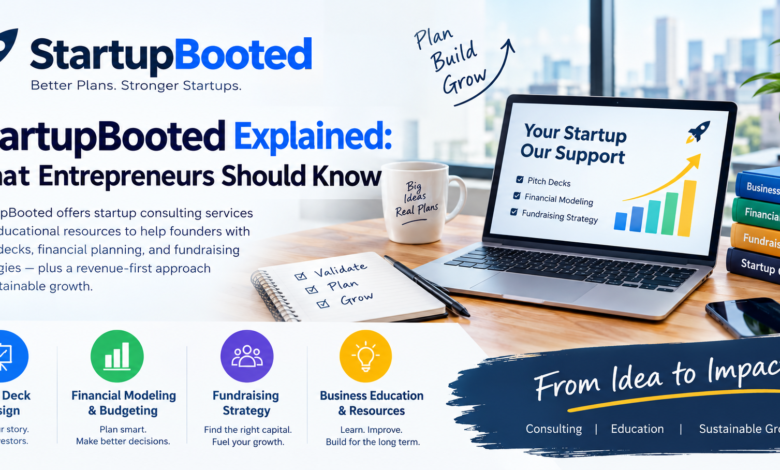
StartupBooted is a name that entrepreneurs may encounter when researching startup consulting, business planning, financial management, and fundraising strategies. It is associated with services designed to help founders prepare investor presentations, understand their financial position, and make more informed decisions about business growth. The name also appears in discussions about a revenue-first approach to entrepreneurship, where founders prioritize customer demand, careful spending, and sustainable growth before depending heavily on outside investment. These two meanings are related, but they are not identical. One refers to a business brand and its advertised professional services, while the other describes a general approach to building a startup. Understanding this distinction can help entrepreneurs evaluate available resources, compare funding options, and decide which strategies best suit their business goals.
Quick Facts About StartupBooted
| Feature | Details |
|---|---|
| Name | StartupBooted |
| Main industry | Startup consulting and business education |
| Primary audience | Entrepreneurs, founders, and small businesses |
| Main services | Pitch deck design, financial modeling, budgeting, and fundraising strategy |
| Business objective | Support better startup planning and financial decisions |
| Related concept | Bootstrapping and revenue-first growth |
| Common topics | Business finance, investment preparation, and sustainable growth |
| Service availability | Advertised through its business website |
| Pricing | Depends on the service and project scope |
| Success guarantee | No guaranteed business or fundraising outcome should be assumed |
What Is StartupBooted?
StartupBooted is a business-focused brand that presents startup consulting services and educational resources for entrepreneurs. Its publicly available service descriptions focus on helping founders communicate their business ideas, understand financial projections, and prepare for investment discussions.
Its consulting offerings include investor pitch deck design, financial modeling and budgeting, and fundraising strategy. These services address different stages of the startup journey, from explaining a business idea to preparing realistic forecasts and considering potential sources of capital. The company’s own website describes these offerings as customized support for startup founders.
The name is also associated with online explanations of a revenue-first growth strategy. In this broader context, founders try to validate their business ideas and generate early revenue before relying heavily on external funding.
It is important to distinguish these meanings. StartupBooted is a brand, whereas bootstrapping is an established business concept. The phrase “startup booted” is sometimes used informally to describe a hybrid approach to startup funding, but it is not a universally standardized business methodology.
For entrepreneurs, understanding this difference is the first step toward deciding whether the company’s services or the broader growth principles are relevant to their needs.
The Main Services Offered by StartupBooted
The company’s advertised consulting services focus on three areas of startup development. Each addresses a different business challenge and may be useful depending on a company’s stage, available resources, and future plans.
Investor Pitch Deck Design
An investor pitch deck is a presentation that explains a startup’s product, market opportunity, business model, financial expectations, and funding requirements.
It helps entrepreneurs communicate their ideas to potential investors in a structured and persuasive way. However, an effective presentation must be supported by credible information rather than attractive visuals alone.
StartupBooted advertises customized pitch deck design, including visual storytelling and assistance with presenting a company’s business narrative. Its public service page lists a starting price of approximately $5,000. This is an advertised starting price, not necessarily the final cost for every project.
A well-prepared pitch deck generally explains the customer problem, the proposed solution, the size of the target market, the competitive landscape, and the company’s revenue model. It should also present realistic financial projections and explain how additional funding would be used.
For example, a startup developing an online scheduling tool might use its presentation to explain how the product saves businesses time, which customers are most likely to pay for it, and how subscription revenue could support future expansion.
The most important consideration is that the presentation accurately reflects the business. No design service can guarantee that investors will provide funding.
Financial Modeling and Budgeting
Financial modeling helps business owners understand how their companies may perform under different conditions. It involves preparing forecasts for income, expenses, cash flow, and other financial measures.
Budgeting complements this process by helping founders decide how much money to allocate to product development, marketing, hiring, and daily operations.
StartupBooted advertises financial modeling and budgeting services, with a publicly listed starting price of approximately $10,000. The actual cost should be confirmed directly with the provider because the work required can vary between businesses.
A financial model can help entrepreneurs answer important questions. How much revenue must the business generate to cover its expenses? How many customers are needed to break even? What happens if sales are lower than expected? How much capital is required to keep operations running?
Consider a software startup that earns monthly subscription revenue. Its founders need to account for development expenses, employee salaries, customer acquisition costs, and the possibility that some customers will cancel their subscriptions.
A realistic financial plan can help the team identify potential cash shortages before they become serious problems.
The model should also be updated as the business gathers new information. Forecasts based on actual customer behavior are generally more useful than projections built entirely on optimistic assumptions.
Fundraising Strategy
Fundraising involves identifying suitable sources of capital and preparing a clear explanation of why the business needs funding.
Depending on its goals, a startup may consider angel investors, venture capital firms, business grants, loans, strategic partnerships, or revenue generated by customers. Each option has different financial and ownership implications.
StartupBooted advertises fundraising strategy support intended to help founders prepare their business positioning, improve investor presentations, and develop a more targeted approach to fundraising. Its website lists a starting price of approximately $2,000 for this service.
Before raising money, founders should determine how much capital they need, what the funds will support, and which milestones they expect to achieve.
For instance, a business may seek investment to expand its sales team after demonstrating that its existing sales process works. Another company may need funding to develop a product that requires expensive research before it can reach paying customers.
In both situations, a well-defined funding plan can help entrepreneurs explain their priorities more clearly.
However, consulting support does not guarantee investment, and the advertised service fee should not be confused with the amount of funding a startup hopes to raise.
Understanding the StartupBooted Growth Strategy
Beyond its consulting services, StartupBooted is associated with a revenue-first approach to building businesses. This approach emphasizes testing customer demand, managing expenses, and using available resources carefully before committing to major expansion.
The underlying principles overlap with bootstrapping, which generally means building a business using personal resources, customer revenue, and reinvested profits instead of relying primarily on outside investors.
The hybrid interpretation leaves room for external funding later. Rather than rejecting investment entirely, founders first try to establish a clearer understanding of their market and financial position.
This approach may work well for businesses that can begin selling products or services without requiring substantial initial capital.
For example, a freelance service business may start with a small client base and use its earnings to purchase equipment, hire support, or expand its marketing. A software company may launch a basic product, collect subscriptions, and reinvest part of its earnings into improvements.
However, not every company can follow this path. Some industries require significant funding before a business can generate revenue.
Benefits of a Revenue-First Approach
A revenue-first strategy offers several potential advantages when it matches a company’s needs.
Better financial discipline: Founders learn to monitor expenses, prioritize necessary purchases, and understand how their financial decisions affect available cash.
Early customer validation: Customers who pay for a product provide evidence that it addresses a problem they consider worth solving.
Greater ownership control: Businesses that rely less on equity investment may allow founders to retain a larger ownership stake and more decision-making authority.
More focused development: Early feedback can help founders identify which product features customers actually value instead of spending resources on unnecessary additions.
Greater funding flexibility: A startup with paying customers and reliable financial records may have more information available when deciding whether to seek external investment.
These advantages can make business planning more practical, particularly for founders working with limited resources.
Nevertheless, revenue-first growth is not a guarantee of profitability. Customer demand can change, expenses can increase, and competitors may have access to considerably more capital.
The goal should be to make better decisions with available information rather than assume that one strategy will work for every startup.
Potential Challenges and Risks
Although revenue-first growth can be useful, entrepreneurs should understand its limitations before making it the foundation of their business plans.
One challenge is the possibility of slower expansion. A startup that reinvests only its earnings may find it difficult to hire specialists, enter new markets, or compete with businesses that receive substantial outside investment.
Cash flow can also create problems. A company may generate sales but still struggle to pay its bills if customers delay payments or unexpected expenses arise. This is why founders need to monitor available cash rather than relying only on reported revenue.
Another limitation is the risk of underinvestment. Excessive cost-cutting may prevent a company from improving its product, protecting its systems, or hiring the people it needs to grow.
The approach may be particularly difficult for biotechnology, advanced hardware, and other capital-intensive businesses. Such companies can require substantial investment before they have a product that customers can purchase.
Entrepreneurs should therefore evaluate their industry’s requirements instead of assuming that avoiding outside capital is always the best decision.
How Entrepreneurs Can Apply These Principles
Founders who want to develop a more disciplined growth strategy can begin with a few practical steps.
First, identify a specific customer problem and research whether people are willing to pay for a solution. Customer interviews, small-scale trials, and early sales can provide useful evidence.
Second, launch a basic version of the product or service when practical. A smaller initial offering allows entrepreneurs to gather feedback without committing all their resources to a fully developed product.
Third, prepare a financial plan that includes expected revenue, operating costs, cash flow, and possible setbacks. Review these estimates regularly and update them when actual business results differ from expectations.
Fourth, reinvest carefully. Prioritize spending that improves customer satisfaction, supports reliable operations, or creates a realistic opportunity for additional revenue.
Finally, evaluate outside funding based on the business’s needs. Investment may be appropriate when the company has a strong opportunity that cannot be pursued effectively with its existing resources.
These steps can provide a useful starting point regardless of whether a founder uses professional consulting services.
Is StartupBooted Worth Considering?
Whether StartupBooted is worth considering depends on the assistance a founder needs and the resources available to pay for it.
A startup preparing for investor meetings may benefit from a well-organized pitch deck. A founder struggling with financial projections may need a detailed model. A business considering investment may require help evaluating funding options and preparing its financial narrative.
However, professional consulting is not necessary for every early-stage business. Some founders can prepare their initial business plans and financial forecasts themselves, using affordable software, educational resources, and feedback from experienced entrepreneurs.
Before choosing a paid service, evaluate the expected value of the work. Ask what documents will be delivered, how many revisions are included, who will perform the work, and whether support continues after the initial project.
It is also important to examine the advertised price in relation to the business’s current stage. A substantial consulting expense may not be appropriate for a business that has not yet demonstrated customer demand.
The most sensible decision is one based on a clear business need, a realistic budget, and a defined expected outcome.
Conclusion
StartupBooted is associated with professional startup consulting and a broader discussion about revenue-first business growth. Its advertised services cover pitch deck design, financial modeling, budgeting, and fundraising strategy, while the related bootstrapping concept emphasizes careful spending and the use of internal resources.
Entrepreneurs should understand the distinction between the brand and the broader business strategy before deciding which information is useful to them.
The most important lesson is that sustainable startup growth requires more than a compelling presentation or a particular funding method. Founders need to understand their customers, manage cash carefully, set realistic goals, and adapt as their businesses develop.
Frequently Asked Questions About StartupBooted
1. What is StartupBooted?
StartupBooted is a brand associated with startup consulting services and business-focused educational content. Its advertised services include investor pitch deck design, financial modeling, budgeting, and fundraising strategy.
2. What does StartupBooted help entrepreneurs with?
Its advertised services focus on preparing investor presentations, analyzing financial information, developing budgets, and preparing for fundraising discussions. The usefulness of these services depends on the founder’s needs and the scope of the engagement.
3. How much do StartupBooted services cost?
Its public service pages list starting prices of approximately $5,000 for pitch deck design, $10,000 for financial modeling and budgeting, and $2,000 for fundraising strategy. These figures may not represent the final price for every project.
4. Is StartupBooted a funding platform?
Its advertised services focus on consulting and fundraising preparation. Entrepreneurs should not assume that purchasing a consulting service means they will receive investment or have funding guaranteed.
5. What does startup booted mean in entrepreneurship?
The phrase is sometimes used informally to describe a business strategy that prioritizes personal resources, customer revenue, and careful spending before relying heavily on external investment. Its meaning can vary by source, and it is not a universally standardized methodology.
6. Is StartupBooted the same as bootstrapping?
No. StartupBooted is a business brand, while bootstrapping is a general approach to building a business primarily through founder resources and operating revenue. The concepts may appear together in discussions of startup growth, but they are different.
7. Can a startup succeed without external investment?
Yes. Some businesses grow through customer revenue and reinvested profits. However, the approach depends on the company’s business model, expenses, industry, and growth ambitions. Other companies need outside capital to develop products or compete effectively.
8. Should every entrepreneur use StartupBooted services?
No. Consulting services are most useful when they address a specific business problem and provide value that justifies their cost. Founders should compare their needs, budget, experience, and available alternatives before purchasing professional support.