
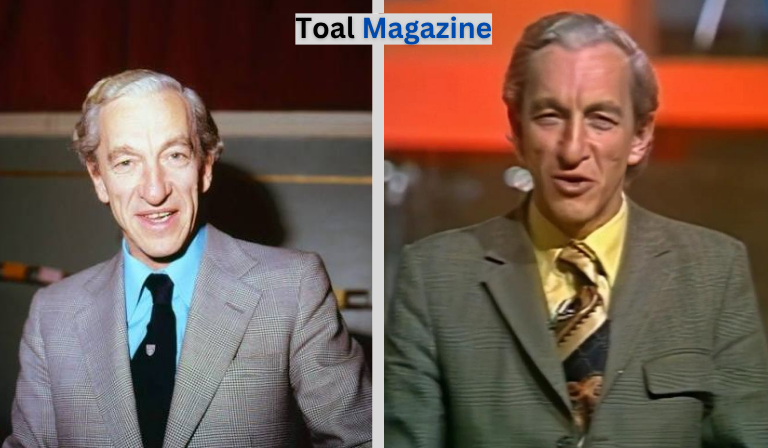
Raymond Baxter was far more than the familiar voice behind the BBC’s Tomorrow’s World. A former RAF Spitfire pilot, broadcaster, commentator, writer, and science populariser, he built an unusual career that connected wartime aviation with Britain’s growing fascination with modern technology. Born on 25 January 1922, he became the first presenter of Tomorrow’s World when the programme launched in 1965 and remained closely associated with it for 12 years. He also covered major state occasions, aviation events, motoring stories, and technological breakthroughs. Raymond Baxter died on 15 September 2006, aged 84, after a career that had made him one of British television’s best-known science presenters. His story remains compelling because of the remarkable journey that took him from combat aircraft to the television studio.
Raymond Baxter Quick Facts
| Fact | Details |
|---|---|
| Full name | Raymond Frederic Baxter |
| Born | 25 January 1922 |
| Died | 15 September 2006 |
| Age at death | 84 |
| Nationality | English |
| Profession | Television presenter, broadcaster, commentator and writer |
| Best known for | Tomorrow’s World |
| BBC role | Original presenter of Tomorrow’s World |
| RAF service | Spitfire pilot during the Second World War |
| Marriage | Married Sylvia in 1945 |
| Children | Graham and Jenny |
| Honour | OBE, awarded in 2003 |
The central facts of his life are well documented in contemporary obituaries, which describe him as a pioneering broadcaster who helped popularise science and technology for a mass audience.
Early Life and Background
Raymond Frederic Baxter was born in 1922 and came of age during one of the most turbulent periods in modern British history. When the Second World War began, a military career became part of his life, and in 1940 he joined the Royal Air Force.
Baxter trained as a pilot and eventually flew the Supermarine Spitfire. His wartime experience was an important part of his later identity because it gave him direct knowledge of aircraft, engineering, technology, and the discipline required to operate in demanding conditions.
His time in the RAF also placed him among a generation that experienced technological development at extraordinary speed. The aircraft and communications systems of the 1940s were already transforming warfare, something that would later make Baxter particularly well suited to explaining new inventions to television audiences.
Raymond Baxter’s RAF and Wartime Career
During the Second World War, Baxter served with several RAF squadrons and flew Spitfires in operational duties. His service was not simply ceremonial; he experienced the realities of military aviation at first hand.
He was mentioned in dispatches for his involvement in a daylight raid connected with attacks on German V-2 rocket facilities in The Hague, according to reports published after his death.
This period became one of the most extraordinary chapters of his life. Before becoming a trusted television presenter, Baxter had already worked in an environment where technical knowledge, precision, and calm decision-making were vital.
After the war, he continued flying, including Mustangs and Dakotas, before moving into broadcasting. He later worked for the Forces Broadcasting Service in Cairo and Hamburg, helping him develop the communication skills that would become central to his future career.
From Aviation to Broadcasting
Baxter’s move from flying into broadcasting was a natural progression. His aviation experience gave him specialist knowledge, while his ability to communicate clearly gave him a route into radio and television.
Over time, he became increasingly associated with commentary and live presentation. He was particularly effective in situations where viewers needed someone capable of describing technical subjects without making them difficult to understand.
That combination of practical experience and broadcasting ability would eventually lead to his most famous role.
Raymond Baxter and Tomorrow’s World
When the BBC launched Tomorrow’s World in 1965, Raymond Baxter became its first presenter. The programme was designed to explore developments in science, engineering, inventions, and emerging technology, making complicated subjects accessible to mainstream viewers.
Baxter remained with the programme until 1977. During those years, audiences saw him introduce and discuss innovations that would become increasingly familiar parts of everyday life, including the pocket calculator, microwave technology, and barcode systems.
The programme became hugely popular. The Guardian’s obituary noted that Tomorrow’s World attracted audiences of up to 10 million at its peak, demonstrating the remarkable public interest in science and technology during the era.
For many viewers, Baxter became the face of technological progress. His calm delivery and polished presentation style gave the show an authoritative character, while his enthusiasm helped make unfamiliar inventions entertaining.
Why Was Raymond Baxter Such a Memorable Presenter?
One reason Baxter stood out was his ability to sound knowledgeable without overwhelming the audience. He had the confidence of someone with practical technical experience, but he also understood that television viewers wanted explanations that were clear and engaging.
His professional manner was especially useful during live broadcasts. According to his obituary, Tomorrow’s World editor Glyn Jones chose him partly because his outside-broadcast experience and ability to cope with unexpected situations were valuable qualities in live television.
That skill helped Baxter become one of the defining presenters of British popular science television.
Major Broadcasting Achievements
Although Tomorrow’s World is the programme most closely linked with Baxter, his career was much broader.
He provided commentary for major national occasions, including the funeral of King George VI and the funeral of Winston Churchill. He also covered the coronation of Queen Elizabeth II in 1953, placing him among the broadcasters trusted with some of the most important public events of his time.
His aviation background also continued to shape his professional work. Baxter reported on Concorde during its early development and became strongly associated with the Farnborough Airshow, which he covered repeatedly over many years.
He also worked as a BBC motoring correspondent and had connections with motor racing and rallying, further showing the unusual range of his interests.
Raymond Baxter and Concorde
Few technological subjects were as exciting to the British public as Concorde. The supersonic aircraft represented speed, engineering ambition, and the possibility of radically changing international travel.
Baxter was well positioned to report on it because of his deep understanding of aviation. His experience as a former military pilot made aircraft technology more than an abstract topic; he could discuss it with genuine knowledge and enthusiasm.
His reporting helped bring aviation developments to viewers who might never have had an opportunity to see such technology up close.
Marriage and Family Life
Raymond Baxter married Sylvia in 1945. She was American, and the couple remained together for many decades.
According to his obituary, Sylvia died in 1996. Their two children, Graham and Jenny, survived him.
Details about Baxter’s private family life were generally less prominent in the public record than his professional achievements. He was best known for his broadcasting work, while his family largely remained outside the spotlight.
His personal life therefore provides a quieter contrast to a career that frequently placed him in front of millions of television viewers.
Personality and Interests
Baxter’s public personality was strongly connected with confidence, optimism, and enthusiasm for technology. He was comfortable around aircraft, cars, inventions, and live broadcasting, and those interests often overlapped throughout his career.
Away from television, he enjoyed activities such as sailing. He also had a strong relationship with the worlds of motoring and aviation, interests that continued long after his wartime flying days.
His professional image was polished, but reports from colleagues and contemporaries also show a more human side. His enthusiasm for unusual demonstrations and inventions helped give Tomorrow’s World its memorable character.
Did Raymond Baxter Have Social Media Accounts?
No verified social-media presence can be attributed to Raymond Baxter. This is unsurprising because he died in 2006, before modern social-media platforms became a major part of public life.
References found online today may include archives, fan pages, video clips, or modern accounts discussing his work, but these should not be confused with official personal profiles belonging to Baxter.
For biographical purposes, established historical and archival sources remain much more useful than social-media pages.
What Happened to Raymond Baxter?
By the late 1970s, Baxter’s time as the central presenter of Tomorrow’s World had come to an end. He left the regular role in 1977 after 12 years, although his association with broadcasting and technology continued.
His departure was connected with changes in the programme’s editorial direction. Later reporting noted that he believed Tomorrow’s World had lost its way during part of its later history, showing that he continued to take an interest in the programme long after stepping away from it.
Baxter continued to work periodically in broadcasting and maintained strong links with events such as the Farnborough Airshow. He was also involved in commemorative broadcasting relating to D-Day.
Rather than disappearing completely from public life, he gradually moved into a later stage of his career in which appearances became less frequent but his reputation remained strong.
Raymond Baxter’s Final Years
Baxter received the OBE in 2003, one of the honours that recognised his contribution to British broadcasting and public life. He was also made a Freeman of the City of London, reflecting his wider standing in British society.
Raymond Baxter died on 15 September 2006, aged 84. Contemporary reports stated that he died at the Royal Berkshire Hospital in Reading, with his children at his side.
His death marked the end of a remarkable career that had stretched from wartime aviation to some of the most influential science and technology broadcasting in Britain.
Raymond Baxter’s Net Worth and Income
There is no sufficiently reliable public figure for Raymond Baxter’s exact net worth at the time of his death. Estimates found on websites today are often unsupported, and presenting a precise amount would therefore be misleading.
What is clear is that Baxter enjoyed a long professional career involving television, radio, writing, commentary, motoring, and aviation. His income would have come from several areas rather than from a single long-term television salary.
Because financial records from broadcasters of his generation are not publicly comprehensive, his exact wealth should be treated as unknown rather than guessed.
Public Image and Legacy
The lasting importance of Raymond Baxter lies in his ability to make science and technology interesting to ordinary viewers.
At a time when television was becoming central to British family life, he helped turn complex subjects into mainstream entertainment. Tomorrow’s World became an important part of that process, and Baxter was its original defining presenter.
His influence can also be measured through the memories of later broadcasters and viewers. Tributes following his death described him as a British television pioneer and praised the way his work inspired interest in science, engineering, and technology.
Even after Tomorrow’s World ended many years later, its reputation remained strong. The programme introduced audiences to inventions that would eventually become ordinary parts of everyday life, and Baxter’s contribution was central to its early success.
Why Raymond Baxter Is Still Remembered
Raymond Baxter’s story remains fascinating because his life crossed several very different worlds.
He was a wartime fighter pilot, yet he later became one of Britain’s leading popular science presenters. He covered royal and national ceremonies, reported on major aircraft developments, worked in motoring, and remained associated with aviation for decades.
That combination made him unusual. He did not simply read information from a script; his background gave him practical experience that added authority to his broadcasting.
For viewers who grew up watching Tomorrow’s World, his voice became synonymous with the excitement of discovering what might come next.
Conclusion
Raymond Baxter’s life was an extraordinary journey from wartime RAF pilot to one of Britain’s most respected television presenters. His work on Tomorrow’s World introduced millions of viewers to inventions and scientific developments while his broadcasting career also covered aviation, motoring, state occasions, and major national events.
He died on 15 September 2006 at the age of 84, but his professional legacy has endured. More than simply a television presenter, Baxter helped create a culture in which science and technology could be exciting, understandable, and relevant to everyday people.
His story is ultimately one of adaptability and curiosity. From the cockpit of a Spitfire to the television studio, Raymond Baxter remained closely connected with the changing technology of his age — and that is why his career continues to attract interest today.
8 FAQs About Raymond Baxter
1. Who was Raymond Baxter?
Raymond Baxter was an English broadcaster, television presenter, writer, and former RAF Spitfire pilot. He was best known as the original presenter of the BBC science programme Tomorrow’s World.
2. When did Raymond Baxter present Tomorrow’s World?
He presented Tomorrow’s World from its launch in 1965 until 1977, making him one of the programme’s defining early personalities.
3. Was Raymond Baxter a Spitfire pilot?
Yes. Baxter served with the RAF during the Second World War and flew Spitfires in operational service.
4. When did Raymond Baxter die?
Raymond Baxter died on 15 September 2006, aged 84.
5. Who was Raymond Baxter’s wife?
His wife was Sylvia, an American whom he married in 1945. She died in 1996.
6. Did Raymond Baxter have children?
Yes. He and Sylvia had two children, Graham and Jenny.
7. What else did Raymond Baxter do besides Tomorrow’s World?
He covered major state occasions, aviation events, Concorde, motoring, and the Farnborough Airshow. He also worked as a BBC motoring correspondent and was involved in other broadcasting projects.
8. What is Raymond Baxter remembered for today?
He is remembered primarily as the original presenter of Tomorrow’s World and as a pioneering broadcaster who helped make science, engineering, aviation, and technology accessible to a mass television audience.