
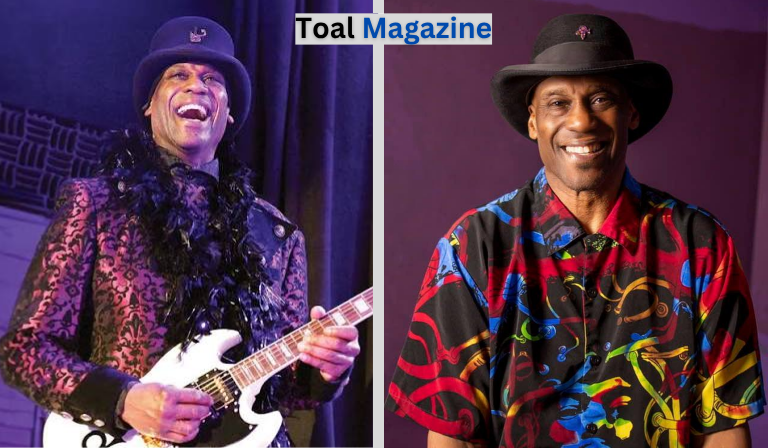
Jelly Bean Johnson, born Garry George Johnson, was an American drummer, guitarist, songwriter, and record producer who became an important figure in the development of the Minneapolis Sound. Best known as the longtime drummer and founding member of The Time, he worked closely with Prince, Morris Day, Jimmy Jam, Terry Lewis, and other musicians who helped put Minneapolis on the global music map.
His career went far beyond performing with The Time. He worked as a session musician and producer, collaborated with major R&B and pop artists, appeared in Purple Rain and Graffiti Bridge, and helped turn an early Janet Jackson piano idea into the rock-driven hit “Black Cat.” He also released his own album, Get Experienced, and devoted part of his later life to preserving Minneapolis music history. Johnson died on November 21, 2025, at age 69, leaving behind a broad musical legacy.
Quick Facts About Jelly Bean Johnson
| Detail | Information |
|---|---|
| Full Name | Garry George Johnson |
| Known As | Jellybean Johnson |
| Born | November 19, 1956 |
| Birthplace | Chicago, Illinois, U.S. |
| Raised | North Minneapolis, Minnesota |
| Profession | Drummer, guitarist, songwriter, producer |
| Best Known For | The Time and the Minneapolis Sound |
| Early Group | Flyte Tyme |
| Major Collaborations | Prince, Janet Jackson, New Edition, Mint Condition and others |
| Famous Production Credit | Janet Jackson’s “Black Cat” |
| Films | Purple Rain, Graffiti Bridge |
| Solo Album | Get Experienced |
| Died | November 21, 2025 |
| Age at Death | 69 |
Early Life and Background
Garry George Johnson was born in Chicago on November 19, 1956. When he was 13, his mother moved the family to North Minneapolis, where he would eventually become part of one of the most influential local music communities in American popular culture.
Johnson later recalled that his mother bought him a drum kit to keep him occupied and away from trouble. He learned by listening closely to music on the radio, absorbing both Black R&B and rock music. He specifically credited the limits of Black radio programming at the time with exposing him to rock acts that broadened his musical interests.
As a teenager, Johnson became friends with other young Minneapolis musicians, including Prince, Morris Day, Jimmy Jam, and Terry Lewis. The musicians played in rival neighborhood bands and performed at local community events, giving them an early opportunity to develop their skills in front of audiences.
Johnson became part of Flyte Tyme, a group that included Jimmy Jam and Terry Lewis. Those early relationships would prove crucial to the rise of the Minneapolis Sound in the following decade.
Age and Physical Features
Jelly Bean Johnson was born on November 19, 1956, and died on November 21, 2025, two days after celebrating his 69th birthday. His family confirmed that he died on the evening of November 21. A cause of death was not publicly reported in the major obituary coverage.
Johnson was also recognizable for his distinctive personal style. FOX 9 described him as having a towering stature and frequently wearing a top hat, details that became part of his visual identity as a Minneapolis musician.
Reliable sources do not establish an exact height or other detailed physical measurements, so those figures are best left unreported rather than repeated from unverified biography websites.
Career and Major Achievements
Johnson’s professional career developed through his work with Flyte Tyme and, most importantly, The Time. When Prince began assembling the group in the early 1980s, Johnson was selected to play drums.
The Time became one of the signature groups associated with Prince’s musical world. Johnson’s drumming helped provide the band’s rhythmic foundation, while Morris Day became its charismatic frontman. The group developed a distinctive mix of funk, rock, new wave, R&B, and synth-pop that became part of the wider Minneapolis Sound.
The band’s repertoire included major songs such as “777-9311,” “Jungle Love,” and “The Bird.” Billboard’s obituary notes that The Time recorded five Top 10 hits on the Hot R&B/Hip-Hop Songs chart during the 1980s and early 1990s.
Johnson’s achievements were not limited to one band. Zildjian’s artist biography credits him as a drummer, guitarist, writer, engineer, and producer who worked with artists including Patti LaBelle, Nona Hendryx, New Edition, Alexander O’Neal, Mint Condition, and The Human League.
Jelly Bean Johnson and Prince
Prince played a central role in Johnson’s professional career. Johnson and Prince knew each other from their North Minneapolis youth, when their bands were part of the same local music community.
According to Johnson’s own recollection, Prince eventually decided to build The Time around Morris Day as the singer and brought Johnson into the group as its drummer. The relationship was professional as well as creative, because The Time became one of the ways Prince expressed his R&B and funk influences.
Johnson later appeared in projects connected with Prince, helping cement his place in the story of the Minneapolis Sound.
Purple Rain and Graffiti Bridge
The Time gained another level of visibility through Prince’s 1984 film Purple Rain.
Johnson appeared with the group in the movie, which became closely associated with the Minneapolis music scene. His presence in the film helped introduce both The Time and its members to audiences beyond the local music community.
He later appeared as himself in Graffiti Bridge, and The Time’s music and performances remained part of the Prince-connected musical universe. Billboard identifies both films as important parts of Johnson’s public legacy.
His custom-made Purple Rain jacket was later donated to the Minnesota History Museum, further connecting his personal history to the state’s music heritage.
Janet Jackson’s “Black Cat”
One of the most notable achievements in Johnson’s production career came through Janet Jackson’s “Black Cat.”
Released in 1990, the song became a No. 1 hit on the Billboard Hot 100. Johnson explained that Jackson initially brought him a short piano phrase, and he suggested transforming it into a harder rock-oriented arrangement.
He helped turn that musical idea into the aggressive guitar-driven track that became “Black Cat.” The record showed that Johnson could move beyond the classic Minneapolis funk style and successfully contribute to mainstream pop-rock.
The song remains one of the clearest examples of Johnson’s work as a producer, arranger, and multi-instrumentalist.
Solo Music and Get Experienced
Johnson eventually stepped forward as a solo artist with The Jellybean Johnson Experience.
His album Get Experienced was released in 2021 and featured a mixture of funk, rock, blues, and R&B influences. The project included collaborations with artists such as Ashley Tamar Davis, LAW, Tracey Blake, Chance Howard, Tony M., and Monte Moir.
The album gave listeners a chance to hear more of Johnson’s own musical personality outside the structure of The Time. It also demonstrated that even after decades in the industry, he remained interested in creating new music.
The Minneapolis Sound
The Minneapolis Sound is one of the most distinctive musical movements to emerge from the United States. It blended funk, R&B, rock, synth-pop, electronic production, and strong rhythmic grooves.
Johnson was one of the musicians deeply connected to its development. His experience in North Minneapolis, his work with Flyte Tyme, and his role in The Time placed him directly inside the community that helped create the sound.
When asked to describe the Minneapolis Sound, Johnson famously reduced it to one word: “Funky.” He repeatedly emphasized the importance of Minneapolis musicians who developed their craft together in neighborhood clubs and community spaces.
Social Media and Public Presence
During his lifetime, Johnson maintained a visible public presence through performances, interviews, music releases, and appearances connected with Minneapolis music.
He was especially active in the local music community and continued performing with Morris Day and The Time. His official online presence now serves largely as a memorial space, featuring information about his life and celebration of life.
There is no reason to assume that every social-media account using his name is an official account, so fans should distinguish between verified or established sources and unofficial profiles.
Marriage and Family Life
Johnson kept much of his private family life away from mainstream entertainment coverage. His family described him after his death as a husband and father, emphasizing his love for his family, friends, and Minneapolis community.
The Minnesota Star Tribune reported that Johnson was survived by his partner and several children. More detailed accounts of his family have appeared through memorial and tribute materials, but the strongest mainstream obituary sources generally focus on his music career and community work rather than providing extensive private-family details.
Does Jelly Bean Johnson Have Children?
Yes. Public obituary coverage confirms that Johnson was a father and was survived by several children. His family was an important part of his life, even though he generally kept personal matters away from the spotlight.
Tribute material published after his death also described him as a deeply family-oriented person who took pride in being a father and creating a welcoming home for relatives. These accounts add a more personal dimension to his public legacy, although details should be distinguished from formally documented biographical information.
Personality and Interests
People who worked with Johnson often described him as a musician who genuinely loved playing.
Zildjian’s biography quotes Johnson saying, “Music is my life; I live to play music.” He also spoke about music as something that could keep young people focused and give them a constructive outlet.
His interests extended beyond one instrument. Johnson was an accomplished drummer and guitarist and also worked as a writer, engineer, producer, and session musician. He continued sitting in with local bands even after becoming an established touring artist, reflecting his continuing connection to the working-musician culture of Minneapolis.
Net Worth and Income
A reliable public figure for Jelly Bean Johnson’s net worth has not been established.
His income came from multiple parts of the music business, including performances, recording, songwriting, production, session work, and collaborations. Zildjian also notes that he received numerous Gold and Platinum album recognitions, along with music and ASCAP awards.
Because there is no authoritative financial disclosure covering his career earnings, assets, royalties, and investments, online estimates should be viewed cautiously. A specific dollar figure would be speculative.
Public Image and Legacy
Johnson’s public image was closely tied to Minneapolis music, but his legacy is broader than his work as The Time’s drummer.
He received recognition for his contributions to music, including a 2014 Local Legends Award. The members of The Time also received a Soul Train Lifetime Achievement Award in 2022, recognizing the group’s lasting impact. (First Avenue)
Perhaps most importantly, Johnson spent his later years helping preserve the history of the Minneapolis music scene. The Minneapolis Sound Museum was established to document the artists, stories, places, and community that created the movement. The museum now honors Johnson as one of its founders.
After his death, Minneapolis held public memorial events celebrating his music and life. MPR News reported that friends and family gathered to remember him in December 2025.
When Did Jelly Bean Johnson Die?
Jelly Bean Johnson died on November 21, 2025, at the age of 69. He had celebrated his 69th birthday only two days earlier on November 19.
His death was widely reported across Minnesota and the national music press. Tributes highlighted his role in The Time, his production work, his contribution to the Minneapolis Sound, and his dedication to preserving local music history.
Conclusion
Jelly Bean Johnson‘s career tells the story of a musician who grew from a young drummer in North Minneapolis into one of the important figures behind the Minneapolis Sound.
His work with Flyte Tyme and The Time established his place in funk and R&B history, while his production career showed a much broader musical range. From Purple Rain to Janet Jackson’s “Black Cat” and his own Get Experienced album, he continued creating and performing across several generations of music.
Perhaps his most lasting contribution was his commitment to preserving the story of Minneapolis musicians. Through the Minneapolis Sound Museum and decades of performances and collaborations, Johnson helped ensure that the city’s musical history would not be remembered only through Prince, but through the many artists who built the sound alongside him.
FAQs About Jelly Bean Johnson
1. Who was Jelly Bean Johnson?
Jelly Bean Johnson was an American drummer, guitarist, songwriter, and producer best known as a founding member and longtime drummer of The Time, the Minneapolis group associated with Prince.
2. What was Jelly Bean Johnson’s real name?
His full name was Garry George Johnson. He became widely known professionally by the nickname Jellybean Johnson.
3. When did Jelly Bean Johnson die?
He died on November 21, 2025, at age 69, two days after his birthday.
4. Was Jelly Bean Johnson in The Time?
Yes. He was a founding member and the band’s drummer. He remained closely associated with The Time throughout his career and continued performing with the group later in life.
5. What songs is Jelly Bean Johnson associated with?
His work with The Time includes songs such as “Jungle Love,” “The Bird,” and “777-9311.” He was also involved with Janet Jackson’s No. 1 hit “Black Cat.”
6. Did Jelly Bean Johnson work with Janet Jackson?
Yes. He helped develop and produce Janet Jackson’s “Black Cat,” transforming an early piano idea into the song’s harder rock-oriented arrangement. The single reached No. 1 on the Billboard Hot 100.
7. Did Jelly Bean Johnson have children?
Yes. Obituary coverage confirms that he was a father and was survived by several children.
8. What is Jelly Bean Johnson’s legacy?
His legacy includes his role in The Time, his work as a producer and session musician, his contribution to the Minneapolis Sound, his solo album Get Experienced, and his efforts to preserve Minneapolis music history through the Minneapolis Sound Museum.